SSDS – Delinking for Self-Determination and Solidarity


Delinking for Self-Determination and Solidarity
 

1. The Present Conjuncture: A Return to Brazen Empire

We are not living in normal times. The current world order is marked by a qualitative escalation of imperial and neocolonial violence. From the ongoing genocide and territorial expansion in Palestine to the military attack in Venezuela and the subsequent open U.S.-backed aggression against Iran; from the Trump administration’s unapologetic embrace of colonial legacies to the weaponization of debt, taxes and sanctions, digitalization, food dependency and recent military threat against– the peoples of Asia, Africa, and the Americas face a systematic assault on their very right to exist autonomously.

This is not merely neocolonialism as usual. We are witnessing a return to direct forms of imperial domination, brazenly justified and militarily enforced. In the verge of the public release of The National Security Strategy (NSS) document -that announce the Doctrine Monroe’s relaunch- The Secretary of State of the United States has openly urged Europe to be less apologetic about its colonial past. In this context, the concept of national sovereignty, let alone popular self-determination, is under direct threat. We are confronting not just an economic crisis, but a crisis of civilization – a terminal phase of senile capitalism that threatens the very survival of humanity and the planet.

2. Why Delinking? Why Now?

Samir Amin’s concept of ‘delinking’ has often been misunderstood as autarky or withdrawal. Properly understood, delinking is a strategic political project: the capacity of a people, a movement, or a nation to subordinate external economic and political relations to internal priorities of social justice, ecological survival, and democratic self-determination. Delinking is not an end in itself, but the necessary condition for building genuine alternatives.

Today, delinking has moved from theory to urgent practice. Iran’s defiance of U.S. financial hegemony – trading in national currencies and cryptocurrencies – is an act of delinking. Palestinian sumud (steadfastness) in the face of settler colonialism is an act of delinking. Venezuelan communes, Mexican solidarity economies, and Burkina Faso’s progressive turn are all experiments in delinking. Even small peasants returning to traditional, non-industrial farming – as 75% of global food producers – are delinking from fossil-fuel-based agribusiness.

Yet these scattered struggles lack a common analytical framework and a platform for mutual learning. This initiative is necessary to identify, analyze, and amplify these emergent practices of delinking. We are not seeking to produce a definitive set of answers, but rather to generate the right questions – questions that can stimulate critical reflection and collective action.

3. On Terminology: Beyond “Global South”

We are mindful of the limitations of the term “Global South.” It is a geographical descriptor that obscures more than it reveals. It flattens immense diversity, masks internal contradictions and conflicts between countries, and risks suggesting a unity that does not exist. Moreover, as some participants noted, a “Global South” country like Brazil can reproduce patterns of dependency in its relationship with China; India and Pakistan are in conflict; and Argentina and Brazil have their own tensions. The term also excludes indigenous peoples in Canada and the United States who are, in a very real sense, post-apocalyptic survivors of colonial destruction, engaged in parallel struggles for self-determination.

Drawing on Frantz Fanon, we prefer the spirit of “the wretched of the earth” (les damnés de la terre) – those who are dispossessed, exploited, and denied the right to determine their own futures. For practical purposes, and to evoke the historical legacy of tricontinental solidarity (Africa, Asia, Latin America), we use the term “Tricontinental” to signal our orientation. We understand this term not as a fixed geography, but as a political positioning: a commitment to building solidarity across the Global Majority against imperialism, fascism, neoliberalism, and the entire model of Western-centric civilization. We build this identity from diversity, not in spite of it.

4. Beyond Economic Nationalism: A Multi-Scalar, Multi-Dimensional Approach

This project rejects both neoliberal globalization and narrow, exclusionary nationalism. Delinking, as we understand it, operates on multiple scales simultaneously, and we propose a multiscalar and multidimensional approach:

  • At the geo-political level: Challenging U.S. hegemony, the dollar system, and military alliances that enforce neocolonial extraction. This includes examining macro-issues such as de-dollarization, extractivism, and the restructuring of global financial architectures.
  • At the nation-state level: Building genuine sovereignty, but only where linked to just class and social relations. This requires critical examination of the successes and failures of national experiments in delinking (e.g., China, Cuba, Venezuela, Iran, Burkina Faso).
  • At the level of communities and movements in struggle: We are not interested in communities or movements in the abstract. Our focus is on those actively engaged in struggle – communities that are resisting dispossession, asserting self-determination, and building alternatives from below. This includes peasants reclaiming food sovereignty, indigenous peoples defending their territories, shack dwellers organizing for land and housing, urban movements challenging extractivism, and cooperative networks building solidarity economies. If they are not in struggle, there is no common ground.
  • At the level of social movements: Examining the contributions and limitations of feminist, environmental, peasant, and cooperative movements in advancing the delinking agenda. We ask: how do these movements relate to the larger project of self-determination? What are their achievements, and what are their shortcomings? Our goal is to stimulate critical reflection, not to provide easy praise. As the meeting discussion noted, decolonial feminist perspectives are crucial here – feminist scholars have argued that delinking must extend to gender equality programming, which all too often “adapt to, rather than dismantle, racist, capitalist, and patriarchal systems”. We will engage with feminist thinkers such as Verónica Gago on the relationship between feminist struggles and delinking, and Catherine Scott, whose work traces how Amin analysed gender within the functioning of neocolonialism.
  • At the level of culture and consciousness: Delinking from Eurocentrism, the ideology of progress, the cult of digitization, and the neoliberal imperative of self-responsibilization (e.g., the “One Person Company” model spreading across Asia). We must decolonize our minds and our imaginations. This includes recognizing that gender analysis is a vital and independent perspective on global inequality that Amin’s framework addressed only in part.

5. Delinking and Interdependence: A Clarification

Delinking does not mean isolation. It means the selective subordination of external relations to internal developmental priorities. It means building interdependence without domination – relationships between peoples and nations that are based on mutual respect, cooperation, and non-colonial reciprocity. This is a fundamental distinction from both imperial dependency and autarkic nationalism.

6. A Political Intervention, Not an Academic Exercise

This initiative is not a conventional research project. It is a political intervention. We aim to produce not only written analyses (country reports, edited volume) but also a series of public webinars, accessible transcripts, and pedagogical materials that can be used by movements, universities, and grassroots organizations. Our methodology is collaborative: we begin with dialogue, not pre-set themes. We prioritize the voices of those engaged in actual struggles over detached scholarship. We recognize that life and struggle must come before theory – though theory is central to guiding and understanding that struggle.

7. Proposed Methodology: Webinars, Country Studies, and Dialogue

(1) Webinar Series: We will organize a series of thematic webinars (approximately monthly) with the following structure:

  • Opening sessions: Focused on Samir Amin’s core framework, inviting scholars and activists to discuss the relevance and limitations of his ideas today. Common readings (2-3 key papers) will be circulated beforehand.
  • Thematic sessions: Covering macro-issues (de-dollarization, climate crisis, extractivism), national case studies (Iran, China, Cuba, Venezuela, Burkina Faso, etc.), social movements (feminism, peasant movements, indigenous struggles, cooperative movements), and cultural/epistemological questions.
  • Feminism and Delinking: A dedicated session will explore how feminist struggles relate to the delinking project, examining both the contributions and limitations of feminist movements in advancing self-determination. This session will engage with decolonial feminist perspectives that challenge Western-centrism in feminist thought and call for a “delinking from Western narratives”.
  • Format: Each session will feature 2-3 speakers from different continents, with an emphasis on dialogue and debate rather than monologue. Simultaneous interpretating  may be provided. 
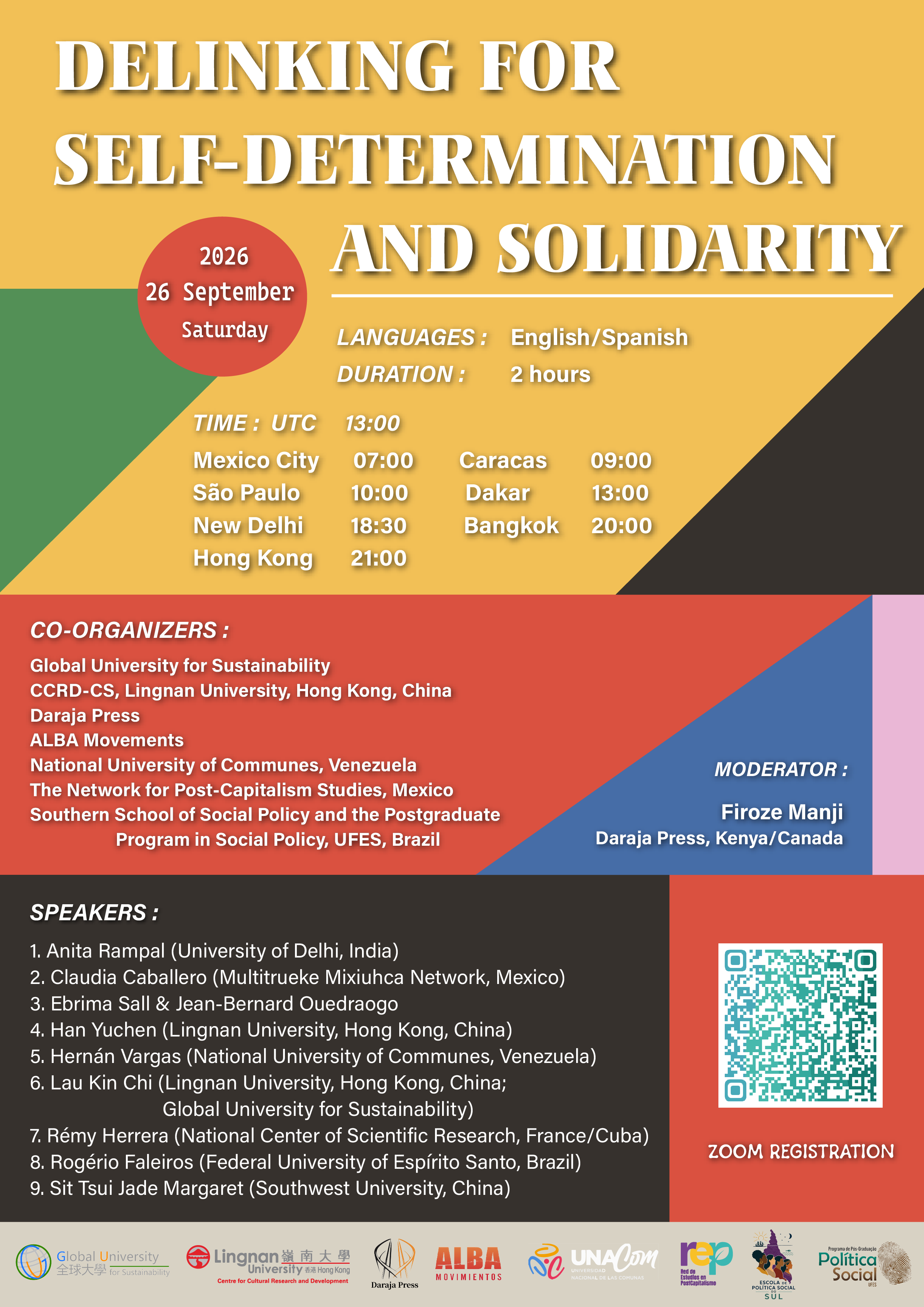
  • Tentative dates (Saturday): 26 September 2026; 31 October 2026; 28 November 2026; 30 January 2027; 27 February 2027.  

(2) Country and Movement Reports: Running in parallel with the webinars, we will commission research teams to produce papers on specific countries or movements. Each team will be self-organizing, with a designated coordinator. We are open to reports from nation-states, regions, and transnational movements. Crucially, we will prioritize reports that emerge from or engage directly with communities and movements in struggle.

8. Guiding Spirit

This project is an invitation to refresh the thought of delinking – to update it, contest it, and apply it to the concrete struggles of our time. It is a space for critical solidarity, for mutual learning, and for political imagination. Without struggle, there is no growth. Without dialogue across difference, there is no solidarity. The task is urgent. The time is now.


Initiators (by alphabetical order):

  1. Anita Rampal (University of Delhi, India)
  2. Ashley Dayman (Lawyer and Editor, Australia)
  3. Claudia Caballero (Multitrueke Mixiuhca Network, Mexico)
  4. Ebrima Sall (Trust Africa, Senegal)
  5. Firoze Manji (Daraja Press, Kenya/Canada)
  6. Han Yuchen (Lingnan University, Hong Kong, China) 
  7. Hernán Vargas (National University of Communes, Venezuela)
  8. Lau Kin Chi (Lingnan University, Hong Kong, China; Global University for Sustainability)
  9. Rémy Herrera (National Center of Scientific Research, France/Cuba)
  10. Rogério Faleiros (Federal University of Espírito Santo, Brazil)
  11. Sit Tsui Jade Margaret (Southwest University, China)

Co-Organizers of the Webinar Series:

  • Global University for Sustainability
  • CCRD-CS, Lingnan University, Hong Kong, China
  • Daraja Press
  • ALBA Movements
  • National University of Communes, Venezuela
  • Southern School of Social Policy and the Postgraduate Program in Social Policy, UFES, Brazil
  • Network for Post-Capitalism Studies, Mexico

This concept paper is a living document, open to revision and enrichment through ongoing dialogue.

Attachment: Three Articles to Accompany the Concept Paper

1. Samir Amin, “A Note on the Concept of Delinking” (1987)

  • Why this one: This is the most concise and direct statement by Amin himself on what delinking means – and what it does not mean. He clarifies that delinking is not autarky, but rather “the organization of a system of criteria for the rationality of economic choices based on a law of value, which has a national foundation and a popular content, independent of the criteria of economic rationality that emerges from the domination of the law of capitalist value that operates on a world scale” . In short: submitting external relations to internal developmental priorities, not the other way around. It also briefly covers the role of the state, the peasantry, and South-South cooperation .


2. Carlos Eduardo Martins, “Samir Amin and the Challenges of Socialist Transformation in Senile Capitalism” (2019)

  • Why this one: This is an excellent contemporary overview of Amin’s later thinking, written shortly after his death. It explains his concept of “senile capitalism” – the terminal phase defined by five monopolies (technology, finance, natural resources, media, and weapons) – and connects his delinking strategy to the broader project of building a Fifth International. It also situates Amin’s work in relation to other world-systems thinkers (Wallerstein, Arrighi, Frank) and addresses the rise of neofascism, making it directly relevant to our current conjuncture .


3. (Optional/Background) Chapter from Delinking: Towards a Polycentric World (1990) – e.g., Introduction or Chapter 1

  • Why this one: For those who want to go deeper, the book Delinking is Amin’s major statement on the subject. A short excerpt (e.g., the Introduction or Chapter 1) would give participants a sense of his full argument: why Third World countries cannot raise living standards if they continue to adjust to the trends of an unequal global system; why delinking requires a broad coalition of popular forces in control of the state; and why it is essential for building a polycentric world.
  • 4. (Reference) Samir Amin’s The Long Revolution of the Global South: Toward a New Anti-Imperialist International, Monthly Review Press, 2019.
  • Samir Amin’s posthumous memoir blends decades of field experience across the Global South with his core anti-imperialist Marxist theory. Amin reviews popular uprisings in Latin America, Africa and Asia, praising mass grassroots movements yet warning fragmented resistance cannot defeat centralized global capital alone. Rejecting Eurocentric development models and superficial humanitarian aid, he frames the Global South’s struggle as a prolonged, unfinished long revolution demanding collective cross-regional solidarity and delinking from exploitative capitalist structures.
  • Free download from Global U website: https://our-global-u.org/oguorg/en/monthly-review/


Concept Paper & Readings